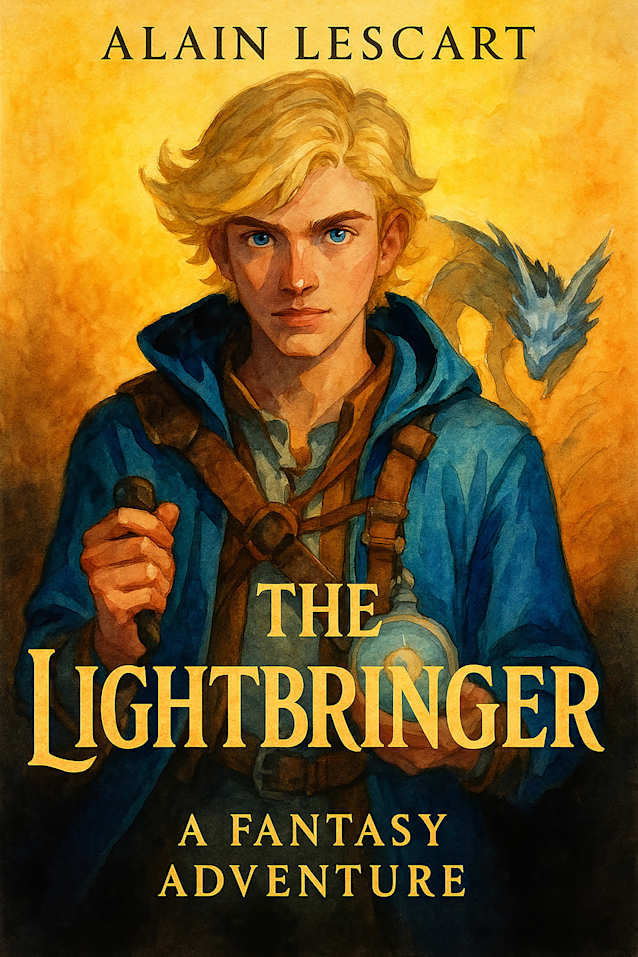
The Lightbringer
About
In "The Lightbringer," an encroaching darkness threatens to plunge the land into eternal twilight. Chosen by destiny, young Silvjär embarks on a dangerous quest to ignite the ancient beacon that holds power to banish the shadows and restore the sun's warming embrace.
Accompanied by the heartful giant Merrit and the whimsical faun Sylvanus, Silvjär's journey is fraught with challenges. Cryptic allies, deceitful enemies, and the whispers of a lonely dragon lurking in the shadows test their bonds and resolve.
Silvjär faces a test of faith and courage as the decisive moment approaches. Will the light prevail, or will darkness consume all? "The Lightbringer" is a tale of adventure, camaraderie, and the age-old struggle between light and darkness. Embark on a journey where the dimmest flicker of hope might be the brightest beacon.
Praise for this book
A fellowship of motley companions embarks on a quest to save the sun in Lescart’s novel.
As the novel opens, protagonist Silvjär is sent away by his father to train under Master Cyndrill, a skilled swordsman. Not long after his departure, Silvjär receives word that fierce warriors have raided his homeland and burned his village. In the absence of news about his family, Silvjär fears the worst. Then, one morning, he finds a truffle that Cyndrill deems extraordinary: “This is the key,” the swordsman says, “and it has chosen you.” As readers learn, a killer had fled into these mountains bearing a curse some years before; during the years when winter lingers too long, shadows emerge “on the night of the solstice” and seek to smother the sun. To counter this event, “three winter elves” choose someone worthy by bestowing a magic truffle on them. The one so chosen must ascend the highest peak in the realm and light a beacon to call back the sun. Because this task has fallen on Silvjär, Master Cyndrill dubs him “the Lightbringer.” Armed with a compass, a fire-starter, and an amulet, Silvjär sets forth alone across a perilous landscape, including vast caverns, giant catfish, a violent river journey, a serpent with ruby eyes, and an angry bear. He acquires companions along the way: a faun named Sylvanus, an amiable giant named Merrit, and a mysterious girl who conceals hidden depths. Initially, this eccentric crew shows little promise. But as they journey together toward the mountains, braving immense dragons, dense fogs, diminutive beings known as Gloom Lurkers, and a cave housing what initially seems to be a creature of monstrous proportions, the characters become irrevocably bound to one another in surprising ways.
Lescart’s novel, written over the course of a decade, immediately distinguishes itself with its evocative scenes of natural beauty. There writing has echoes of Tolkien, not least in a cave sequence featuring an exchange of riddles, though the book draws much of its inspiration from the fantasy tradition that preceded Tolkien. Early modern fairy tales and Norse myths are a clear influence. As Silvjär wanders early on through a largely unpeopled landscape and meets with adventures that defy logic, his quest has a dreamlike air. In these moments Lescart succeeds in doing what Tolkien argued is the chief aim of all fantasy: to cast a spell over the reader. This he achieves with astonishing visuals (moonlight, frost, spruces, “a deep blue pool streaked with ribbons of green”) and language that is plain but lyrical, avoiding archaisms and ill-conceived stabs at grandeur (“The catfish flashed white,” he writes, “enormous and swift, its scales catching the faint light like dull moonstone”). If the book has a weakness, it’s that the setting can feel at times hazily sketched (locations are given names like Troll’s Climb, Ogre Mound, and Goblins Crack), while (as is often the case in the fantasy genre) the principal characters suffer from a lack of personality. However, Lescart’s poetic ear and his evident delight in myths, legends, and fairy stories make this a journey worth taking.
An all-too-familiar fantasy tale that’s redeemed by moments of descriptive beauty.